Platform
One platform for the whole decision loop.
Five engines and one governance layer carry raw data all the way to a decision that is tested, carried out and then learned from. All of it runs on your infrastructure: your own data center, an in-country cloud or an air-gapped network.
The problem
Today’s stack is fragmented. Data platforms store, BI displays, solvers compute but need an operations-research PhD, and planning tools serve only the supply chain.
Evidence
>27,000
government applications in Indonesia that do not talk to each other.
Source: Kompas, 27 May 2024; confirmed by the civil-service ministry (KemenPANRB), 13 Feb 2025
Our answer
One shared model from data to outcome, with a trail an auditor can inspect at every step.
Understand, decide, act, learn.
Every decision passes through the same four steps. The engines at work in each step share one model.
-
Understand
What is happening, where, and to which objects?
Data from every source becomes one living model of objects, relationships and actions.
-
Decide
Which plan is best within real limits, and how robust is it?
The best plan is computed, then tested against thousands of possible futures.
-
Act
Who does what, and who approved it?
Agents prepare the action and ask for approval; the action is written back to the source system.
-
Learn
What actually happened, and what needs correcting?
Real outcomes return to the same objects, and models are recalibrated for the next decision.
Back to Understand
01Ontology & data fusion
Pinax: Ontology & data fusion
πίναξ · tablet, map, catalogue. Also the name of the first world map (Anaximander) and of the Pinakes, the catalogue of the Library of Alexandria.
- Engine: in design
- Heritage: running today
Fuse every source into one living model of objects, relationships and actions.
Every institution keeps its data in different places, under names and region codes that rarely match. Pinax fuses them into one living model: objects such as a village, a school-meal kitchen, a contract or a vessel, the relationships between them and the actions allowed on them. Apps and agents work on those objects, not on raw tables.
Capabilities
-
Connectors for every source
Connectors pull data automatically from APIs, databases, files, satellite imagery, ship and aircraft sensors (AIS, ADS-B), open sources and documents, including through a connector agent inside your own network. Nobody copies data by hand any more, and every source records when it was last refreshed.
-
Entity resolution for Indonesian identities
Entity resolution automatically matches variant spellings of people and companies, addresses and region codes across agencies such as the election commission (KPU), Statistics Indonesia (BPS) and the Ministry of Home Affairs. Teams stop reconciling the same lists again and again, and match coverage is reported for every administrative level.
-
An open-format lakehouse
Data lives in the open Apache Iceberg format, geometry and geography types included, so maps of regions, land and hazards are first-class data. Teams query it with the engine they prefer, and the data can always leave without conversion.
-
Lineage and write-back
Every derived dataset records its own lineage, and every action (a disposition, a reallocation, a field assignment) is logged as a transaction that can be written back to the source system. Teams can trace any figure back to its source, and Euthyna’s access markings travel along the same path.
How it works
- Connectors pull data into a lakehouse on your infrastructure.
- Pipelines prepare and derive tables, recording lineage at every step.
- Rows are indexed into objects and relationships: village, kitchen, contract, vessel.
- Apps and agents call objects and actions through an SDK, without writing SQL.
Open foundations
- Apache Iceberg
- Apache Polaris
- Apache Kafka
- Apache Flink
- Dagster
- OpenLineage
- Trino
- DuckDB
- PostgreSQL
- PostGIS
- pgvector
The data layer adopts open components under permissive licences. The Ontology Runtime, where objects, relationships and actions live, is ours to build.
Syntrichia heritage · running today
A regional hierarchy down to the polling station, KPU-to-BPS code crosswalks and scheduled connectors to public data already run on the founder’s platform. All of it becomes the reference ontology from day one.
-
823,378
polling stations in one hierarchy with 83,860 villages across 38 provinces.
Source: Syntrichia national election database, 2024 election. Vote data from KPU Sirekap; stations that never uploaded are not counted
-
94.2%
of 2019 village codes matched to 2024 by name (regencies 100%, districts 98.6%).
Source: Syntrichia 2019 election integration, 2026
-
70+
scheduled data pipelines.
Source: Syntrichia process configuration, checked 28 Sep 2026
02Mathematical optimization
Abax: Mathematical optimization
ἄβαξ · the Greek counting board, ancestor of the abacus.
- Engine: in design
- Heritage: running today
Compute the best plan within real limits of budget, capacity and time.
Proven mathematical solvers already exist, but formulating a model still takes an operations-research PhD. Abax formulates and solves for the best plan directly on Pinax objects, within real limits of budget, capacity and time, then explains why that plan was chosen. Big decisions stop resting on intuition and spreadsheets.
- LP
- MIP
- CP
- vehicle & vessel routing
- facility location
- assignment
- scheduling
- budget allocation
Capabilities
-
Models on live objects
Problems are formulated directly on Pinax objects, for example assigning every school to one kitchen within a serving-time limit and a portion capacity. Nobody exports data to another tool, and the model uses the latest data every time it re-solves.
-
Plans that explain themselves
Every result is written back as a Plan object with its binding constraints, its dual values (what relaxing one limit would change in cost) and a plain-language explanation. Officials see why the plan was chosen, and the system points out which limit costs the most.
-
From plain words to a model, verified
An agent may propose a formulation from a plain description, but every proposal passes an automatic verification pipeline: unit checks, tests on small cases with known answers, a test for each constraint, an explanation when the model is infeasible, a comparison with a simple heuristic, and sign-off by a human modeller. Teams move fast without accepting an untested model.
-
Archipelago templates
Templates for problems an archipelago actually has: kitchen-to-school assignment, multi-tier food and fertiliser distribution, inter-island shipping with back-haul, generator scheduling on isolated grids and regional budget allocation. Teams start from a tested model, not a blank page.
-
DecisionOps
Model versions, shadow runs (the new plan runs alongside the old way before it goes live), baseline comparison, a decision log and rollback. Teams can change how they work safely, and the system flags it automatically when real outcomes drift from the plan.
Illustration · illustrative data
- Hub opened
- Hub closed
- Destination district
- Shipment
- 90
- variables (6 binary), 20 constraints
- 5,578.90
- optimal cost, with Perak, Belawan, Makassar and Sorong open
- 14.4%
- integrality gap against the LP relaxation (4,773.89): the open-or-close choices decide the outcome
- +3.8%
- cost if Perak is closed (5,789.96); Priok opens in its place
Source: Abax demo model, tested 28 Sep 2026 and cross-checked with HiGHS and an enumeration of all 63 hub combinations. Capacities, demand and costs are synthetic; coordinates are real
How it works
- The problem is formulated as a model on ontology objects.
- The model is written in an open modelling layer (Pyomo, linopy or MathOpt) and sent to a solver through an adapter.
- Results return as Plans and Recommendations, with binding constraints, dual values and an explanation.
- A person approves; the plan runs through Pinax actions, and its real outcomes are logged for calibration.
Open foundations
- HiGHS · MIT
- SCIP · Apache 2.0
- OR-Tools CP-SAT · Apache 2.0
- cuOpt · Apache 2.0
cuOpt runs on GPUs and excels at large LPs and routing; its MIP capability is still in beta. Commercial solvers such as Gurobi, Xpress, CPLEX or Hexaly plug in through the customer’s own licence (BYOL). Solvers can be swapped without rebuilding the application.
Source: licences in the official HiGHS, SCIP, OR-Tools and cuOpt repositories, 2026
Syntrichia heritage · running today
The optimization asset running today is still heuristic: the Electoral District Simulation Lab optimizer (greedy search plus simulated annealing) with an ensemble of neutral maps as a baseline. Its algorithms come along as a heuristics library; Abax’s MIP engine is built new.
-
151 ms
run time of the district optimizer (greedy search plus simulated annealing).
Source: Syntrichia Electoral District Simulation Lab, 2026
-
1,000
neutral maps in the baseline ensemble.
Source: Syntrichia Electoral District Simulation Lab, 2026
03Scenario simulation
Theatron: Scenario simulation
θέατρον · a place for viewing: scenarios staged before they happen.
- Engine: in design
- Heritage: running today
Test a decision against thousands of futures before you commit.
The cheapest plan on paper can collapse when a port closes or rice prices spike. Theatron tests a decision against thousands of possible futures before it is carried out, and returns the spread of outcomes, the probability of missing the target and the weak points. Decision-makers choose the most robust plan, not just the cheapest.
Capabilities
-
What-if without touching production
Scenarios run on a branch of the ontology: demand rises, a port closes for weather, prices spike. Teams experiment freely with no risk to production data, and every scenario is stored with its assumptions.
-
Four ways to simulate
Discrete-event simulation for queues and facilities, agent-based models for how populations and markets behave, system dynamics for long-run policy and Monte Carlo for uncertainty. Teams pick the method that fits the question, and results always come back as a distribution, never a single number.
-
Stress-testing Abax plans
Abax plans are stress-tested in Theatron automatically before they go up for approval. Decision-makers see how likely a plan is to miss its target, and the system flags the weak points that need a buffer.
-
Forecasting and foresight
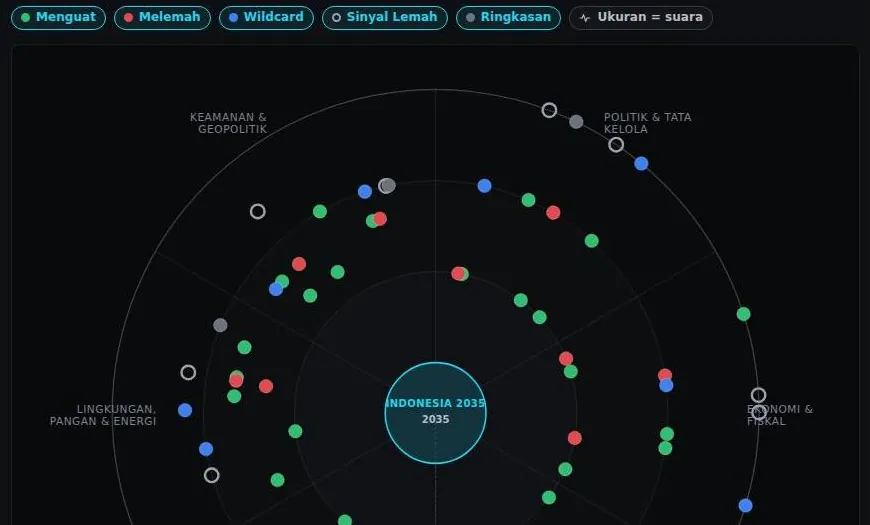
Forecasting, horizon scanning and long-range scenarios in one place, on the same objects as day-to-day operations. Planning teams see weak signals earlier, and the radar marks trends that strengthen, fade or arrive as a surprise.
How it works
- Pick an Abax plan or a policy you want to test.
- Set the uncertainties: demand, weather, prices, travel times.
- Theatron runs thousands of scenarios on an ontology branch, never touching production data.
- Results return as distributions, failure probabilities and weak points, ready to compare across plans.
Open foundations
- SimPy
- salabim
- Mesa
- Ciw
Open simulation libraries are adopted as they are. Scenario orchestration, binding to ontology objects, branching and reporting are ours to build. Digital twins are built as a federation of sector twins on a shared ontology, not one giant model.
Syntrichia heritage · running today
The Foresight Platform (trend radar, horizon scanning, futures tables and scenarios) and the Polycrisis Radar already run on the founder’s platform. Both become registered models in Theatron; the polycrisis model’s accuracy has not yet been evaluated.
-
59
indicators across 7 Polycrisis Radar domains, 51 of them already populated.
Source: Syntrichia Polycrisis Radar, Sep 2026
-
8,866
observations since 1994 as indicator history.
Source: Syntrichia Polycrisis Radar, Sep 2026
04AI agents
Phronesis: AI agents
φρόνησις · practical wisdom (Aristotle): the virtue of deciding well in real situations.
- Engine: in design
- Heritage: running today
Agents that work on your model, ask for approval and leave a trail.
An AI agent that writes free-form SQL and acts without permission has no place in a public institution. Phronesis agents work on Pinax objects and actions, call Abax and Theatron as tools, and ask the responsible official for approval before acting. Every step leaves a trail you can inspect.
Capabilities
-
Agents on the ontology
An agent’s tools are Pinax functions and actions exposed through the Model Context Protocol (MCP); the language model never writes free-form SQL. Teams know exactly what an agent may touch, and every tool call is logged automatically.
-
A governed model gateway
The gateway routes every request by its data marking: SECRET data goes only to self-hosted models, personal data is redacted automatically, and quotas and audit apply to all. Teams use AI without worrying that sensitive data leaves the infrastructure.
-
A human in the loop
Risky actions wait for approval, and the level of human involvement follows the risk of the decision, in line with the ASEAN Guide on AI Governance and Ethics. The approval screen shows the uncertainty and asks for a reason, so approval never becomes a rubber stamp.
-
Evaluation in Indonesian
Every agent is tested with evaluation suites in Indonesian and regional languages, including checks that the figures in a report match their source objects. Teams know an agent’s quality before they use it, and any drop in quality is caught automatically.
Illustration · an agent at work
- Task Prepare options to reallocate rice stocks for East Nusa Tenggara this week.
- Read objects Stock, Warehouse, Price, District
- Call Abax Reallocation options within warehouse and fleet capacity
- Test in Theatron Scenarios with rising demand and a closed port
- Cited memo Every figure points to its source object
- Awaiting approval The agency head decides; a reason is required
- Trail in Euthyna Question, data, models, approver
How it works
- A user sets a task, for example preparing options to reallocate rice stocks for East Nusa Tenggara this week.
- The agent traverses the relevant objects and calls Abax to build the options.
- The options are tested in Theatron against realistic scenarios.
- The agent drafts a cited memo and proposes an action that waits for the responsible official’s approval.
- The full trail (the question, the data read, the models called, who approved) is kept in Euthyna.
Open foundations
- vLLM
- SEA-LION
- Sahabat-AI
- Model Context Protocol
- Inspect
- lm-eval
- SEA-HELM
- IndoMMLU
Regional models can run on the customer’s own GPUs: SEA-LION v4.8 is MIT-licensed and supports Indonesian; Sahabat-AI v2 covers Indonesian, Javanese, Sundanese, Batak Toba and Balinese. Models can be swapped without rebuilding the application, including for a provider the customer chooses under a formal contract.
Source: official model cards for SEA-LION v4.8 (18 Sep 2026) and Sahabat-AI v2 (May 2025) on Hugging Face
Syntrichia heritage · running today
Already running on the founder’s platform: STRATEGIST, an agent that reads only through a closed list of tools and writes cited documents; a Regulation Copilot that answers with article-level references; and the Issue Intelligence report generator, checked by an automated judge.
-
±21
cited, read-only tools in the STRATEGIST agent, capped at 40 documents per 24 hours.
Source: Syntrichia AI Strategist module, Sep 2026
-
6,976
national legal documents in the Regulation Copilot catalogue; 158,345 article passages indexed.
Source: Mirror of the JDIH Setneg catalogue, synced 28 Sep 2026
-
1,477
automated tests guard the Issue & Media Intelligence module.
Source: Syntrichia Issue & Media Intelligence module, 18–22 Sep 2026
05Sovereign deployment
Hermes: Sovereign deployment
Ἑρμῆς · the messenger who crosses borders.
- Engine: in design
- Heritage: running today
One platform that runs in your data center, in-country cloud or a fully air-gapped network.
Public-sector data must be managed and stored in Indonesia, and some of it must never touch the internet at all. Hermes ships the same platform to your data center, an in-country cloud, an air-gapped network or a kit aboard a ship or at a border post, as signed releases you can verify. Without this layer, every sovereign installation turns into a manual services project.
Source: Government Regulation (PP) 71/2019, Article 20 (public-scope electronic systems)
Capabilities
-
Signed releases
Every release is packaged automatically as a signed bundle (cosign) with an SBOM, the full list of its software components. Security teams can verify exactly what is installed, and a bundle whose signature does not match is rejected automatically.
-
Pull-based GitOps with constraints
Each site pulls its own updates through dev, staging and stable channels, subject to constraints such as schema versions, maintenance windows and no upgrades during live operations. Operations teams stop patching site by site, and a release later found vulnerable (a CVE) can be recalled.
-
Air-gapped as a first-class mode
For isolated networks, signed bundles travel on physical media or through a one-way transfer and install with no outbound connection. Defense and intelligence users run the same platform as everyone else, not a version that lags behind.
-
An edge kit for the field
A compact K3s kit with a GPU for ships, border posts, command vehicles and disaster response. Field teams keep their models and data when the signal drops, and the kit syncs itself once the link returns.
Illustration · release topology
How it works
- A hub in an Indonesian data center publishes signed releases.
- Each site (spoke) pulls releases according to its channel and constraints.
- Isolated networks receive bundles on physical media or through a one-way transfer.
- One-way telemetry is optional and carries system health only, never your data.
Open foundations
- RKE2
- Talos
- K3s
- Zarf
- Flux
- cosign
- Harbor
Delivery primitives are adopted from open components: RKE2 for government and defense, Talos for immutable appliances, K3s at the edge. The constraint engine, release channels and air-gap procedures are ours to build.
Syntrichia heritage · running today
Per-client deployment already runs: provincial and national packages on dedicated servers, electoral-district packages on shared servers. The pattern is right, but it is still done by hand. Hermes replaces it with immutable images and GitOps.
Governance layer
Euthyna: Governance layer
εὔθυνα · the accountability audit every Athenian official faced at the end of office.
- Engine: in design
- Heritage: running today
Purpose-based access, markings that follow the data and a tamper-evident audit trail.
A platform that fuses an institution’s data gives it great power to see. Euthyna balances that power with purpose-based access, markings that follow the data and a tamper-evident audit trail, at every layer of the platform. Governance becomes part of the product, not a compliance binder in a drawer.
Capabilities
-
Two-layer authorization
OpenFGA decides who may do what to which object, project and organisation; Cedar evaluates attributes such as markings, classification and purpose. Admins manage policy in one place, and policy analysis surfaces gaps before a rule takes effect.
-
Markings that follow the data
PUBLIC, RESTRICTED, PERSONAL DATA and SECRET markings pass automatically to every derived dataset through lineage. Nobody re-labels derived tables by hand, and access narrows by itself as soon as sensitive data is joined in.
-
A purpose gate
Before opening sensitive data, a user picks the legal basis (the law and the article) and writes a justification; every project carries a purpose card that limits which datasets may be joined. Leaders know why data was opened, and joins outside the stated purpose are refused automatically.
-
An audit trail that cannot be rewritten
An append-only log chained with cryptographic hashes records every access and action, ready to export to inspectorates, internal auditors, the Audit Board (BPK) or an independent auditor. Audits no longer start with gathering evidence, and access-anomaly reports assemble themselves.
-
Personal data and the PDP Law
A scanner recognises Indonesia-specific sensitive data (national ID and family-card numbers, tax IDs, medical records, children’s data, biometrics), with built-in pseudonymisation and automatic retention. DPIA templates and a data-protection-officer workflow help teams meet Law 27/2022.
Illustration · markings follow the data
How it works
- Identity through Keycloak (OIDC or SAML) with mandatory MFA, or through your own identity provider.
- Every request is decided by OpenFGA (relationships) and Cedar (attributes and purpose).
- Markings flow through Pinax lineage to every derived dataset.
- Every access decision and action enters a hash-chained log you can export.
Open foundations
- Keycloak
- OpenFGA
- Cedar
- OpenLineage
Identity and authorization engines are adopted from open components. The marking model, propagation through lineage, the purpose gate and audit export are ours to build.
Syntrichia heritage · running today
Already running on the founder’s platform: user-activity auditing (logins, IP addresses, page trails) with scheduled retention, a role matrix with regional scopes, and an A/B/C data policy (public, processed, derived). All of them seed Euthyna’s policies.
Architecture
One stack, read from the bottom up.
Each layer builds on the one beneath it. Euthyna runs across all of them, so access rules and the audit trail apply the same way from infrastructure to mission applications.
Read from the bottom up
- Customer infrastructure Your own data center, an in-country cloud, an air-gapped network or an edge kit in the field.
- Hermes Signed releases, pull-based GitOps and air-gapped bundles to every site. Core: Governed Delivery
- Pinax An Ontology Runtime on an open-format lakehouse: objects, relationships, actions, lineage. Core: Ontology Runtime
- Abax & Theatron Decision engines bound to ontology objects: optimization and scenario simulation. Core: Decision Engine
- Phronesis Agents that use objects, actions and the decision engines as tools, with human approval.
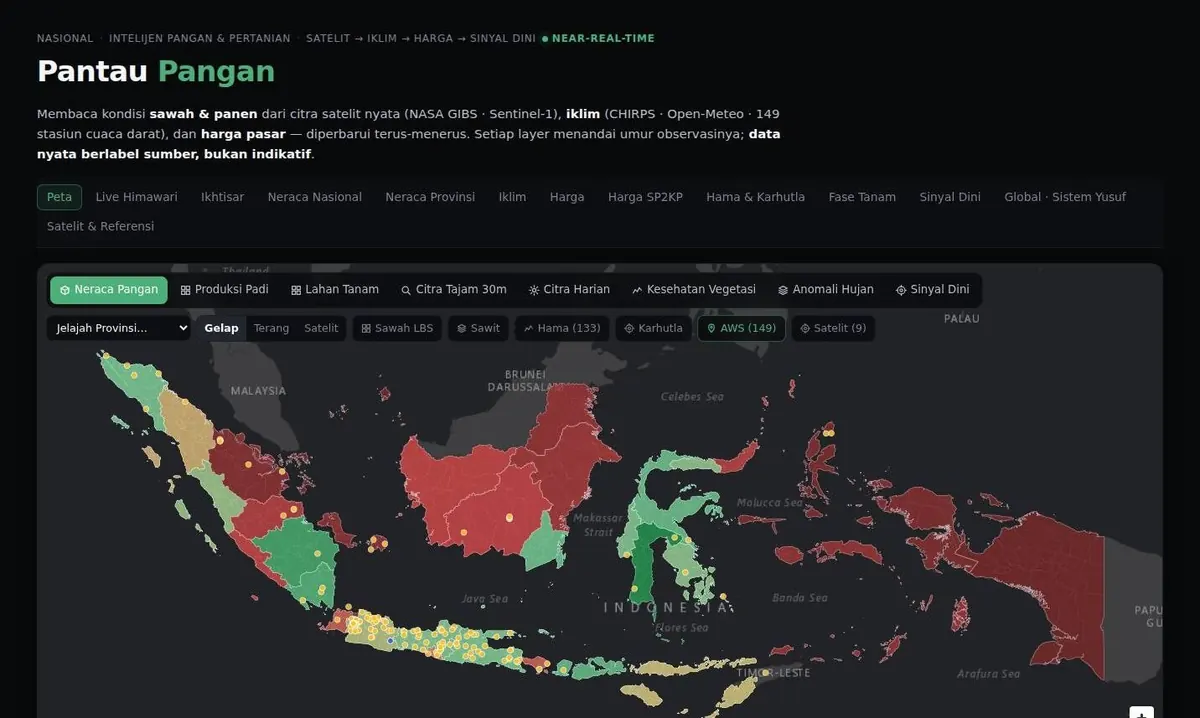
- Mission applications Pantau Pangan (food monitoring), Issue & Media Intelligence, the Priority Program Control Room, Electoral Intelligence (analisadapil.ai) and more.
Euthyna runs across every layer: identity, authorization, markings and audit.
We build three cores ourselves. The data layer, runtime, model serving and solvers use permissively licensed open components. Anything shipped to a customer is licensed Apache-2.0, MIT, BSD or MPL-2.0 only.
Design principles
An open exit
Iceberg, Parquet and ontology export to RDF/OWL/SHACL. A written exit plan from the first contract.
Swappable solvers and models
Solvers and language models change without rebuilding the application.
A white box
The formulation, limits, assumptions, data version and model version behind every recommendation are open to auditors.
Indonesian first
Interfaces, model explanations, agent evaluation and output documents in Indonesian.
Get started
See this loop at work on your own data.
We start from one high-value decision and the data you already hold, and show every assumption behind the result.